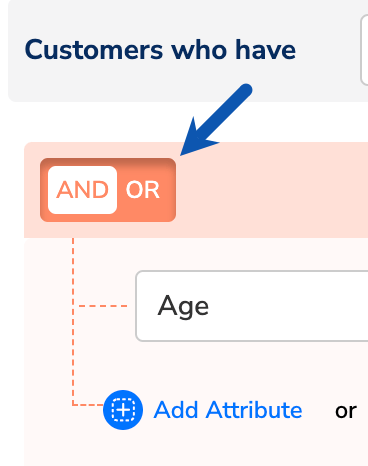
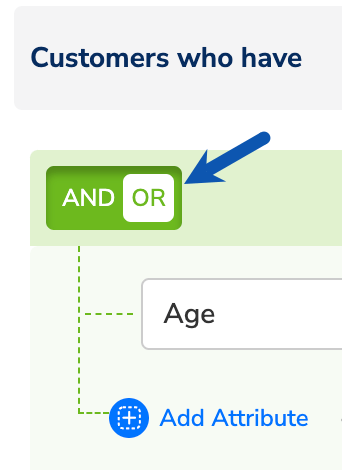
NoteThis page contains large tables. To improve readability, collapse the left panel.
This section helps you understand the different operators to be used while working with the attributes and building the audience.

Logical Operators: AND/OR/NOT

Logical operators help in defining conditions for audience segmentation.
OperatorDescriptionOPERATOR IDENTIFICATION
ANDIncludes customers only if all specified conditions are met.
ORIncludes customers if at least one specified condition is met.
NOTExcludes customers who meet a specific condition.

Example: Segmenting Users Based on Conditions

To better understand these operators, let’s consider an example with two conditions:
  • Condition A – The customer is of the gender male
  • Condition B – The customer has performed an event in the last 15 days
Logical OperatorDefinitionExample ConditionsCustomer ProfileIncluded in Audience?Reason
ANDIncludes customers only if all conditions are true. Excludes if any condition is false.Gender = “Male” AND Event in Last 15 DaysGender: Male, Last Event: 10 days ago✅ YesBoth conditions are true.
ANDIncludes customers only if all conditions are true. Excludes if any condition is false.Gender = “Male” AND Event in Last 15 DaysGender: Male, Last Event: 20 days ago❌ NoThe event condition is false.
ORIncludes customers if at least one condition is true. Excludes only if both conditions are false.Gender = “Male” OR Event in Last 15 DaysGender: Male, Last Event: 20 days ago✅ YesThe gender condition is true.
ORIncludes customers if at least one condition is true. Excludes only if both conditions are false.Gender = “Female” OR Event in Last 15 DaysGender: Female, Last Event: 10 days ago✅ YesThe event condition is true.
ORIncludes customers if at least one condition is true. Excludes only if both conditions are false.Gender = “Female” OR Event in Last 15 DaysGender: Female, Last Event: 20 days ago❌ NoBoth conditions are false.
NOTExcludes customers who meet a specific condition. Includes those who do not satisfy it.NOT (Gender = “Male”)Gender: Male❌ NoThe condition matches, so the customer is excluded.
NOTExcludes customers who meet a specific condition. Includes those who do not satisfy it.NOT (Gender = “Male”)Gender: Female✅ YesThe condition does not match, so the customer is included.

Operators Based on Data Types

When applying attributes, use the different data types accepted by the system to provide values for the fields. For example, when providing customer information such as gender, you can only input a string value like male or female. Below, you can find information about the different data types and the operators available for the them in the system.

String Operators

String values store textual information, such as gender (for example “male” or “female”) or city (for example, “New York,” “London”). The following table explains how different string operators work with examples:
OperatorDescriptionExample ConditionUser ProfileIncluded in Audience?Reason
EqualMatches an exact string value.Gender = “Male”Gender: Male✅ YesThe value matches exactly.
Not EqualExcludes users with the exact value.Gender ≠ “Male”Gender: Female✅ YesThe value is different from “Male”.
ContainsIncludes users if the value contains a specific substring.City contains “York”City: New York✅ Yes”New York” contains “York”.
Not ContainsExcludes users if the value contains a specific substring.City not contains “York”City: New York❌ No”New York” contains “York”, so the user is excluded.
InIncludes users if the value matches any value in a list.City in (“New York”, “London”)City: London✅ Yes”London” is in the specified list.
Not InExcludes users if the value matches any value in a list.City not in (“New York”, “London”)City: Paris✅ Yes”Paris” is not in the specified list.
Begins WithIncludes users if the value starts with a specific substring.City begins with “San”City: San Francisco✅ Yes”San Francisco” starts with “San”.
Not Begins WithExcludes users if the value starts with a specific substring.City not begins with “San”City: San Diego❌ No”San Diego” starts with “San”, so the user is excluded.
Ends WithIncludes users if the value ends with a specific substring.City ends with “ton”City: Boston✅ Yes”Boston” ends with “ton”.
Not Ends WithExcludes users if the value ends with a specific substring.City not ends with “ton”City: Houston❌ No”Houston” ends with “ton”, so the user is excluded.
ExistsIncludes users if the attribute has a value.Email existsEmail: user@example.com✅ YesThe user has an email value.
Does Not ExistExcludes users if the attribute has no value.Email does not existEmail: (empty)✅ YesThe email field is empty, so the user is included.

Integer Operators

Integer values represent whole numbers such as age, purchase count, or event occurrences. The following table explains how different integer operators work with examples:
OperatorDescriptionExample ConditionUser ProfileIncluded in Audience?Reason
Greater or Equal (>=)Includes users if the value is greater than or equal to a specified number.Age >= 18Age: 20✅ Yes20 is greater than 18.
Lesser or Equal (<=)Includes users if the value is less than or equal to a specified number.Age <= 18Age: 16✅ Yes16 is less than 18.
Greater (>)Includes users if the value is strictly greater than a specified number.Purchase Count > 5Purchases: 6✅ Yes6 is greater than 5.
Less (<)Includes users if the value is strictly less than a specified number.Purchase Count < 5Purchases: 4✅ Yes4 is less than 5.
Equal (=)Includes users if the value matches exactly.Age = 30Age: 30✅ YesThe value matches exactly.
Not Equal (≠)Excludes users if the value matchesexactly.Age ≠ 30Age: 25✅ Yes25 is different from 30.
InIncludes users if the value matches any number in a list.Age in (25, 30, 35)Age: 30✅ Yes30 is in the specified list.
Not InExcludes users if the value matches any number in a list.Age not in (25, 30, 35)Age: 40✅ Yes40 is not in the specified list.
ExistsIncludes users if the attribute has a value.Order Count existsOrder Count: 10✅ YesThe user has an order count value.
Does Not ExistExcludes users if the attribute has no value.Order Count does not existOrder Count: (empty)✅ YesThe field is empty, so the user is included.

List of Objects (LOO) Operators

List of Objects (LOO) operators apply when an attribute contains multiple values, such as a list of purchased products, visited locations, or transaction records. The following table explains how different List of Object operators work with examples:
OperatorDescriptionExample ConditionUser ProfileIncluded in Audience?Reason
ANYIncludes users if at least one object in the list meets the specified condition.Purchased Products ANY = “Laptop”Purchased Products: [“Laptop”, “Tablet”, “Phone”]✅ YesThe list contains “Laptop”.
ALLIncludes users only if all objects in the list meet the specified condition.Purchased Products ALL ≠ “Refurbished”Purchased Products: [“New Laptop”, “New Phone”]✅ YesAll products are not “Refurbished”.

Object/Non-Customer Data (NCE) Operators

Object/NCE Operators In Profile Attributes

When using Object attributes or Non-Customer Entities (NCE) in audience segmentation, you must specify the relevant properties or attributes in the audience criteria. The available operators depend on the data type of these properties, such as String or Integer.
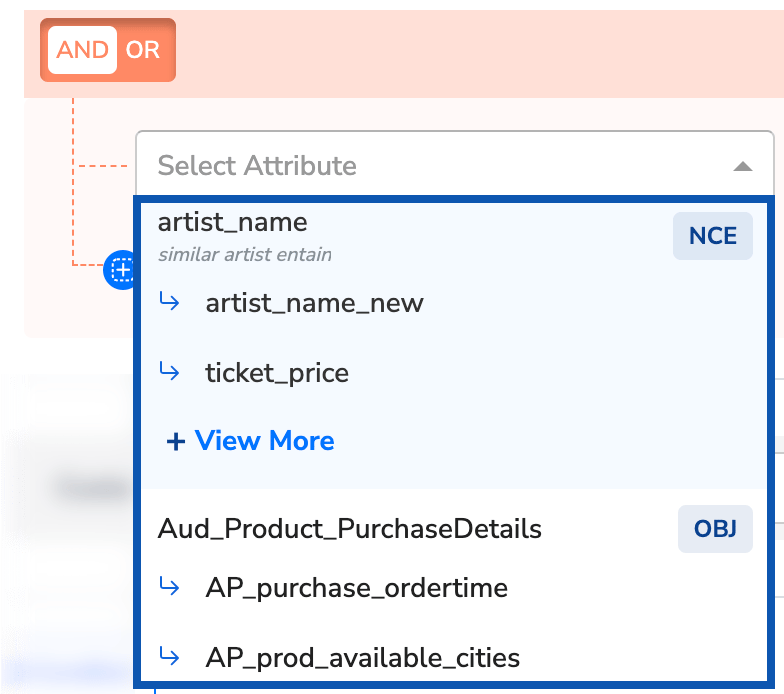
How It Works

  • If you select an Object, include its properties in the audience criteria.
  • If you select an NCE, include its attributes in the audience criteria.
  • Operators vary based on the data type of the chosen properties or attributes.
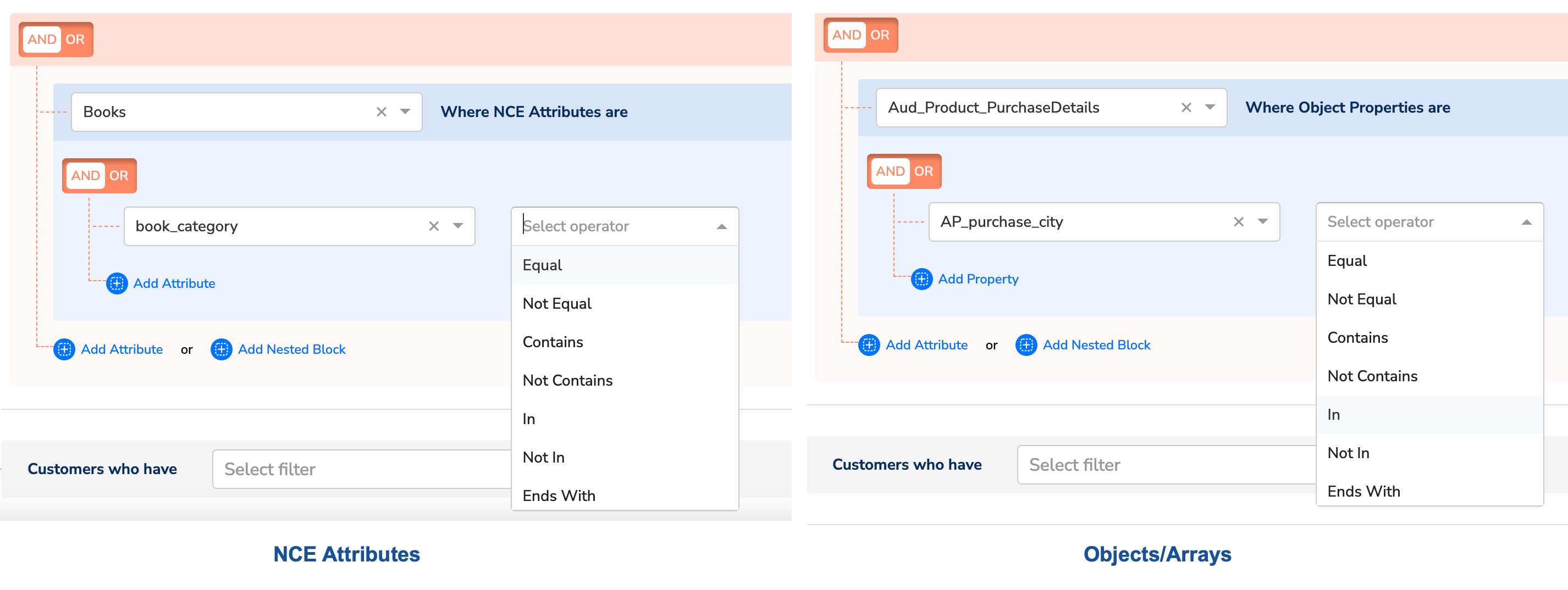
Object/NCE Operators In Calculated Attributes

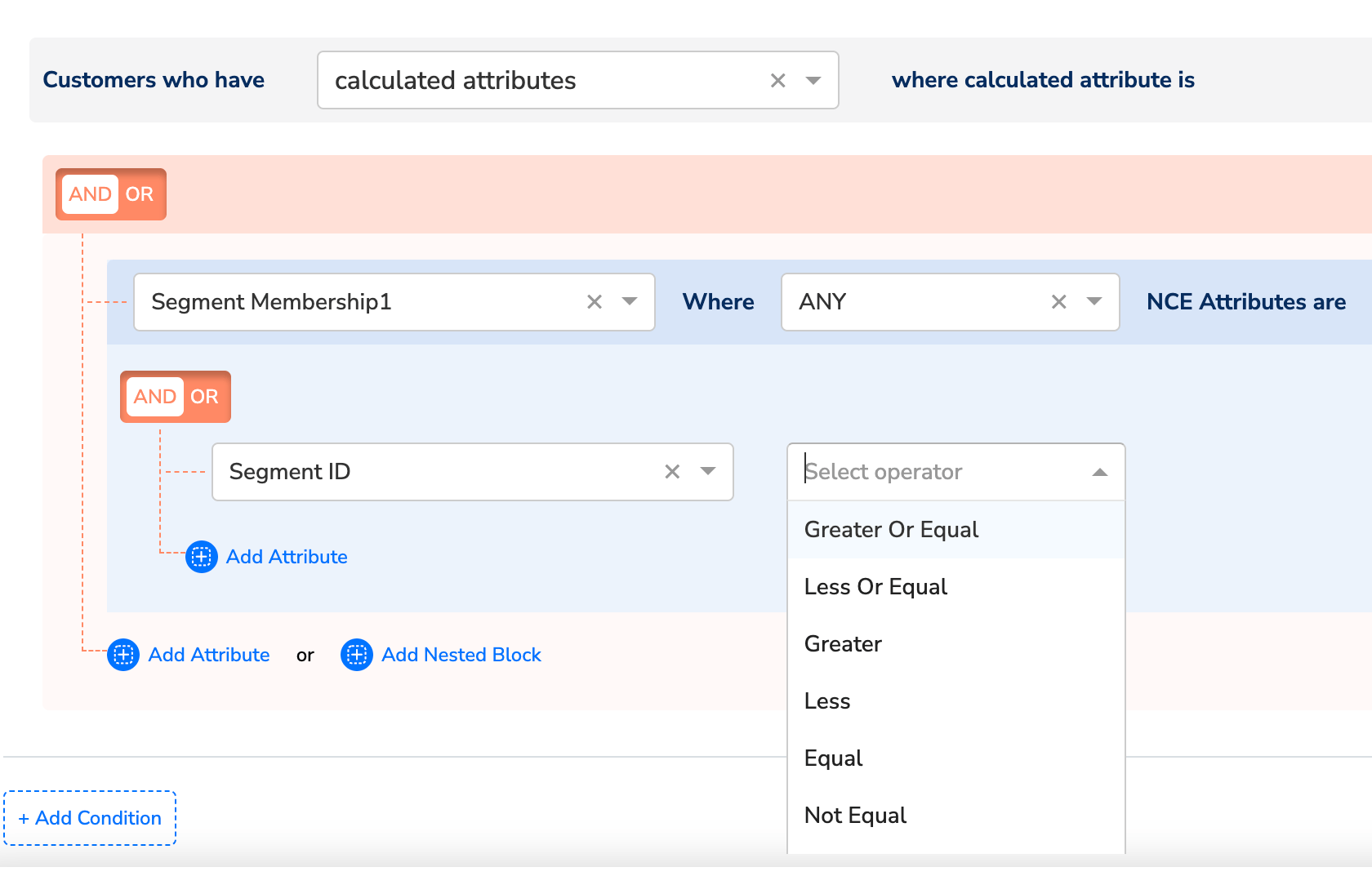
When Objects or Non-Customer Entity (NCE) attributes are used in Calculated Attributes, the ANY or ALL operators are available. Based on the data type (String or integer) of the selected Object property or the NCE attribute, different operators are displayed as shown below.
Event Based Operators

Event operators define conditions for audience segmentation based on Event Attributes. Depending on whether you choose Event Name or Event Properties, different operators apply.

Example Scenario

A company tracks user interactions as events. The Event Name could be “Purchase,” “Login,” or “Add to Cart,” while Event Properties could include details like “Category” (Electronics, Clothing, an so on) or “Payment Method” (Credit Card, PayPal, and so on).
OperatorExample ConditionUser ActivityIncluded in Audience?Reason
EqualEvent Name = “Purchase”Event: Purchase✅ YesThe event name matches “Purchase.”
Not EqualEvent Name ≠ “Login”Event: Purchase✅ YesThe event name is different from “Login.”
InEvent Name IN (“Purchase”, “Checkout”)Event: Purchase✅ Yes”Purchase” is in the specified list.
Not InEvent Name NOT IN (“Logout”, “Cancel Order”)Event: Add to Cart✅ Yes”Add to Cart” is not in the exclusion list.
ExistsEvent Property (Category) EXISTSCategory: Electronics✅ YesThe event has a “Category” property.
Does Not ExistEvent Property (Category) DOES NOT EXISTEvent: Login (No Category)✅ YesThe “Category” property is missing for this event.

Timestamp Operators

Timestamp operators filter users based on when an event occurred. These operators apply after selecting an Event Attribute (such as “Add to Cart,” “View Page,” or “Checkout”).

Example Scenario

A company tracks customer interactions using events like “Purchase”, “Login”, and “Abandoned Cart”. The system records a timestamp for each event.
OperatorExample ConditionUser Activity TimestampIncluded in Audience?Reason
Within the LastEvent: Purchase within the last 7 daysPurchase on Feb 15 (Today: Feb 20)✅ YesThe event happened within the last 7 days.
Within the NextEvent: Subscription Renewal within the next 5 daysRenewal on Feb 25 (Today: Feb 20)✅ YesThe event is scheduled within the next 5 days.
Between the LastEvent: Checkout between the last 10 and 30 daysCheckout on Feb 1 (Today: Feb 20)✅ YesThe event happened within the past 10–30 days.
Between the NextEvent: Trial Expiry between the next 3 and 10 daysExpiry on Feb 25 (Today: Feb 20)✅ YesThe event is set to occur in the next 3–10 days.
Between DatesEvent: Login between Jan 1 and Jan 31Login on Jan 15✅ YesThe event occurred within the specified date range.
BeforeEvent: Account Created before Jan 1Account created on Dec 20✅ YesThe event happened before the specified date.
AfterEvent: Upgrade after Feb 1Upgrade on Feb 10✅ YesThe event occurred after the specified date.
On DateEvent: Payment on Feb 10Payment made on Feb 10✅ YesThe event date matches the specified date.
Not on DateEvent: Refund not on Feb 5Refund on Feb 7✅ YesThe event date is different from the specified date.
AnytimeEvent: Login anytimeLogin on any date✅ YesThe event has no time restrictions.
Did Not HappenEvent: Subscription Renewal did not happenNo renewal event recorded✅ YesThe user has no recorded event for renewal.
Consent operators filter customers based on their consent status. These operators help segment users based on whether they have agreed to data processing or other terms.
OperatorExample ConditionUser Consent StatusIncluded in Audience?Reason
Consent GivenUsers who have given consent✅ Consent Given✅ YesThe user has provided consent.
Consent Not GivenUsers who have not given consent❌ Consent Not Given✅ YesThe user has explicitly denied or not provided consent.
Information Not PresentUsers with missing consent data❓ No Consent Data✅ YesNo consent information is available for the user.

Marketing Preference Operators

Marketing preference operators filter customers based on their opt-in status for marketing communications.
OperatorExample ConditionUser Marketing PreferenceIncluded in Audience?Reason
Preference GivenUsers who have opted into marketing✅ Subscribed✅ YesThe user has opted into marketing.
Preference Not GivenUsers who have not opted into marketing❌ Not Subscribed✅ YesThe user has opted out or not subscribed.
Information Not PresentUsers with missing marketing preference data❓ No Preference Data✅ YesNo marketing preference information is available for the user.
Last modified on February 26, 2026